


About Us
The GCM Research Ethics Committee (GCM REC) was created last January 10, 2024 under the Center for Health Research & Innovation of the College. It was later transferred under the Vice President’s for Operations Office to maintain its independence from the CHRI, and academic department. The Committee Implements its Standard Operating Policies (SOP) contained in its SOP Manual. Its authority applies to its students, faculty and non-teaching staff who performs research using human participants. The College provided administrative, legal, financial and logistic support for the operation of the GCM REC.
GCM Organogram
This section presents the central organizational structure of Gullas College of Medicine, highlighting key offices, administrative divisions, academic departments, and support units that manage and oversee the institution’s operations and medical education programs.
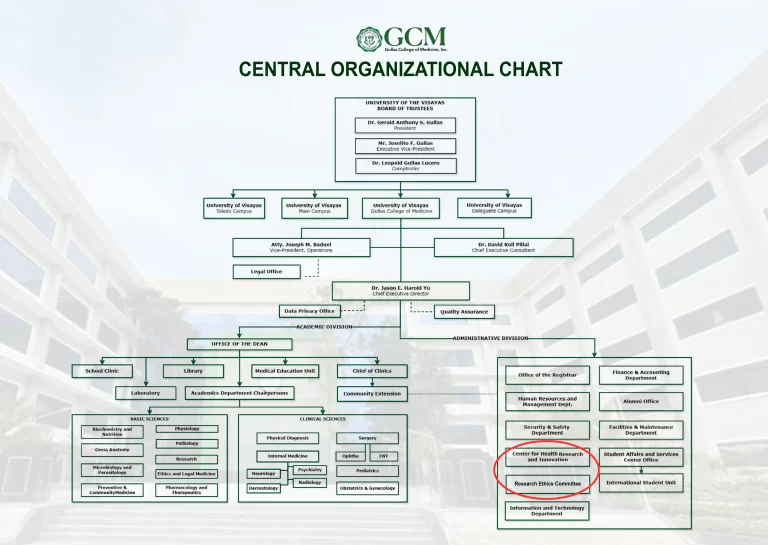
REC Organogram
This section presents the current membership structure of the GCM Research Ethics Committee. The organogram shows the committee’s officers, members, and support structure involved in the ethical review and oversight of GCM research.
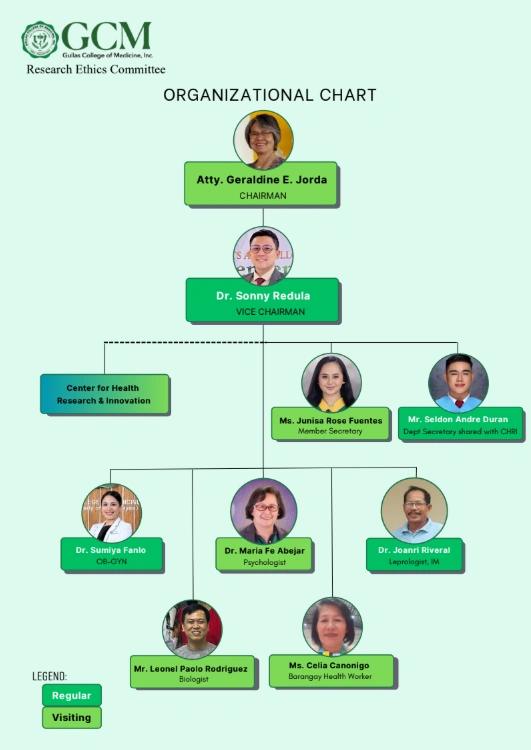
Membership List
This section provides a detailed membership list of the GCM Research Ethics Committee, including names, affiliations, specialties, REC positions, and remarks on their roles and responsibilities within the committee.
SOP Manual
The Standard Operating Procedures of the GCM Research Ethics Committee provide a guide for the ethical review and oversight of research involving human participants. These procedures support a consistent, transparent, and quality review process while protecting the rights, safety, dignity, and well-being of research participants.
Introduction
SOP NO. 1 – SELECTION AND APPOINTMENT OF REC MEMBERS
SOP NO. 2 – DESIGNATION OF REC OFFICERS
SOP NO. 3 – APPOINTMENT OF INDEPENDENT CONSULTANTS
SOP NO. 4 – EXEMPTED FROM REC REVIEW
SOP NO. 5 – EXPEDITED REC REVIEW
SOP NO. 6 – FULL COMMITTEE REC REVIEW
SOP No. 7- MANAGEMENT OF INITIAL SUBMISSION
SOP NO. 8 – MANAGEMENT OF RESUBMISSION
SOP NO. 9 – MANAGEMENT OF PROGRESS REPORT
SOP NO. 10 – REVIEW OF AMENDMENTS
SOP NO. 11 – REVIEW OF PROTOCOL NONCOMPLIANCE/DEVIATION/ VIOLATION
SOP NO. 11A – REVIEW OF REPORTABLE NEGATIVE EVENTS (RNE) REPORT
SOP NO. 11B – REVIEW OF SERIOUS ADVERSE EVENTS
SOP NO. 12 – APPLICATION FOR CONTINUING REVIEW
SOP NO. 13 – REVIEW OF THE FINAL REPORT
SOP NO. 14 – REVIEW OF EARLY TERMINATION REPORT
SOP NO. 15 – MANAGEMENT OF APPEALS
SOP NO. 17 – PREPARING FOR A MEETING
SOP NO. 18 – PREPARING THE MEETING AGENDA
SOP NO. 19 – CONDUCT OF MEETINGS
SOP NO. 20 – PREPARING THE MINUTES OF THE MEETING
SOP NO. 21 – COMMUNICATING REC DECISIONS
SOP NO. 22 – MANAGEMENT OF INCOMING/OUTGOING COMMUNICATION
SOP NO. 23 – MANAGEMENT OF ACTIVE FILES
SOP NO. 25 – MANAGEMENT OF ACCESS TO CONFIDENTIAL FILES
SOP NO. 26 – MANAGEMENT OF QUERIES AND COMPLAINTS
SOP NO. 27 – WRITING AND REVISING SOPS
Researchers may view or download the full SOP Manual below.
REC Forms
1.3 Appointment Letter For REC Mmeber
1.5 Conflict of Interest Declaration Form
2.2 Appointment of REC Officer Letter
3.1 Invitation Technical Expert with Conforme
3.2 Appointment Letter as Independent Consultant
4.0 Application for Ethics Review
4.1 Exemption from Ethical Review
4.2a ICF for Children Less 18 Yrs
4.2c ICF For Qualitative Studies
4.5 Informed Consent Form Evaluation Worksheet
4.10 Waiver of Informed Consent
4.11 Certificate of Exemption from Review
5.1 Invitation Primary Reviewer with Conforme
11.1 Non Compliance, Deviation & Violation Report Form
11A.1 Reportable Negative Event Form
11B.2 SAE SUSAR Assessment Report
12.1 Application for Continuing Review
19.1 Attendance Sheet For Study
Memoranda and Guideline
- Research Guidelines
- Creation of REC
- Relocation of REC
- Requiring Ethics Review
- Research Fee for Exempted
- Research Fee for Expedited
- Research Fee for Full Board
- Memorandum on Fees for Amendment of Research Titles, Proposals, ICF or combination thereof.
- Full Board ethics review of GCM research on mental health, mental stress, and psychology and/or psychiatry-related topics
- Research title amendments fee
- Protection of REC Members from Unjust Removal and Safeguarding Tenure of Research Ethics Committee (REC) Members
- Empowerment of the Gullas College of Medicine (GCM) Research Ethics Committee (REC) and/or the Center for Health Research & Innovation (CHRI) to suspend or Terminate Research Studies
- Mechanisms for Responding and Caring for Research-Related Injuries
REC Review Processes
Flowchart of REC Review Procedures
This section explains the step-by-step process for studies that may qualify for exemption from ethics review. It covers initial submission of research documents, verification and encoding by REC staff, assessment of ethical issues, determination of whether full board review is required, and the issuance of the REC Certificate of Exemption once approved .
Flowchart of REC Procedures: Exempted Review
Shows the review process for studies that may qualify for exemption from ethics review, including reviewer assignment, document evaluation, communication of results, and issuance of the REC Certificate of Exemption when approved.
Flowchart of REC Procedures: Expedited Review
Outlines the process for minimal-risk studies reviewed by assigned reviewer/s or independent consultants, including evaluation, approval of review results, communication to the researcher, and issuance of the REC Certificate of Expedited Review when approved.
Flowchart of REC Procedures: Full Board Review
Presents the process for studies requiring full board ethics review, including reviewer assignment, committee meeting deliberation, decision communication, possible revisions or appeal, and issuance of the REC Certificate when approved.
Flowchart of REC Procedures: Post-Approval Algorithm
Presents the process after REC approval, including the issuance of the Notice to Proceed, participant recruitment and informed consent, continuing review, progress reporting, site visits, amendments, violation management, REC decision communication, final report submission, and archiving or closure of the ethics
Frequently Asked Questions (FAQs)
FAQ guide for the Research Ethics Committee (REC) at the Gullas College of Medicine, designed to align with national health research frameworks ( like the Philippine Health Research Ethics Board – PHREB) and global institutional guidelines.
- What is the purpose of the UV Gullas College of Medicine Research Ethics Committee (REC)
- The REC is an independent body tasked with reviewing, approving, and monitoring research protocols involving human participants. As per memo issued by GCM, all research by GCM and the VGMH should undergo REC review. Kindly refer to the study can be exempted by the GCM REC. Its primary goal is to protect the rights, safety, dignity, and well-being of all research participants, while ensuring that the data collected is scientifically valid and ethical.
- Does my study really need ethical review?
- Yes, if it involves human participants, their identifiable data, or biological samples. This includes:
- Clinical trials and biomedical studies.
- Epidemiological and public health research.
- Social science surveys, questionnaires, or interviews involving patients, students, or community members.
- Retrospective chart reviews using medical records.
- Crucial Rule: You must secure REC approval before any participant recruitment or data collection begins. Ethical approval cannot be granted retroactively.
- Yes, if it involves human participants, their identifiable data, or biological samples. This includes:
- What documents do I need to submit for an initial interview?
- To initiate a review, researchers generally need to provide a complete submission packet. Ensure all tools, questionnaires, and consent forms have explicit version numbers and dates.
- Application Form (Form 4.0) addressed to the REC chair.
- Notice to Proceed from the CHRI (proof that your research has already been vetted and approved for scientific merit by your technical service panel
- The Full Research Proposal: Must include (Title, abstract, methodology, inclusion/exclusion criteria, data analysis plan, and clear ethical considerations)
- Informed Consent Forms (ICF): Provided in English and translated into the local dialect (typically Cebuano/Bisaya) depending on your target study population. This is incorporated in the proposal and must conform with the latest proposal template of the Research Department.
- Data Collection Tools: Questionnaires, case report forms (CRFs), or interview guides.
- Researcher Credentials: Updated, signed, and dated Curriculum Vitae (CV) of the Principal mInvestigator (PI) and co-investigators. This is included in the proposal.
- Certification of QQ validity/reliability
- Protocol Summary Sheet (Form 4.8)
- REC review checklist (Form 4.4)
- Informed Consent Form Worksheet (Form 4.5)
- To initiate a review, researchers generally need to provide a complete submission packet. Ensure all tools, questionnaires, and consent forms have explicit version numbers and dates.
- How are protocols classified for review?
- When you submit your study, the REC filters it into one of three review pathways based on the level of risk to participants:
| Review Type | Risk Level | Common Examples |
Exempted from Review | No predictable risk to humans. | Secondary use of completely anonymous public data; internal institutional evaluations. Note: Only the REC can officially declare a study exempt. |
Expedited Review | Minimal risk (no greater than routine daily life or physical/psychological exams) | Retrospective chart reviews, non-invasive surveys on non-sensitive topics, collection of minimal biological samples (e.g. saliva) |
Full Committee Review | Greater than minimal risk or involves vulnerable | Clinical trials involving pharmaceuticals or medical devices, invasive procedures, or studies involving minors, pregnant women, or prisoners. |
- How long does the ethical review process take?
- Expedited Reviews: Typically take 3 to 4 weeks, as they are evaluated by selected committee reviewers rather than waiting for a full monthly meeting.
- Full Committee Reviews: Can take 4 to 6 weeks depending on the meeting schedule, the complexity of the study, and how quickly the investigator responds to clarifications.
- What are the possible decisions the REC can make?
- Following a review, you will receive an official notification with one of the following outcomes:
- Approved: You are clear to begin your study immediately.
- Approved with Minor Modifications: The study is fundamentally sound, but you need to tweak minor language elements (usually in the Informed Consent Form) before final sign-off.
- Major Revisions Required: The protocol needs significant safety or methodological restructuring. You must resubmit the updated version for another review.
- Disapproved: The study presents ethical risks that outweigh its scientific benefits or violates critical protections.
- Following a review, you will receive an official notification with one of the following outcomes:
- What must I do once my study is approved?
- Approval does not mean your communication with the REC is over. As the investigator, you are required to:
- Stick to the Protocol: You cannot change your methodology, survey questions, or team members without submitting a Protocol Amendment to the REC for approval.
- Report Adverse Events: Any unexpected harm, side effects, or breach of data privacy must be reported to the committee immediately.
- Submit Progress/Final Reports: For long-term studies, you will need to submit annual progress reports for continuing review. A final closure report is mandatory upon study completion.
- Approval does not mean your communication with the REC is over. As the investigator, you are required to:
- Does GCM REC review studies outside UPM/PGH?
- No, the GCM REC does not review studies from medical schools outside GCM. For non-GCM investigators who wish to do a research study in GCM or VGMH, the PI must identify a collaborator assigned in that specific unit/department/site.
- Are the reviews done electronically?
- All reviews are conducted on a hybrid basis. Panel actions are sent to investigators through electronic mail and by hand during submission.
- Do I still need to submit hard copies?
- Yes. Submission of hard copy is required by the GCM REC. However the GCM REC also handle electronic submissions only.
- How do I contact GCM REC?
- Inquiries can be coursed through e-mail and/or face-to-face at the REC office on the 2/F of the GCM main building. Guests are encouraged to prepare documents needed during their inquires or visit so we can respond promptly.
- How do I know the status of my application?
- You will receive a decision letter from the REC office and an email notifying you that your study protocol registration application has been accepted. For follow-ups or inquiries you ay visit the REC office or send an email to the address provided below sduran@gcm.edu.ph
- How do I apply for initial review?
- Register your study with REC office using Form 4.0 and other required forms or get the same forms at CHRI Office
- How would the Principal Investigator know if he already has an approved GCM REC ethics review application?
- The GCM REC will give you an REC code through email or hand carry. If the Principal Investigator does not have an official REC code, s/he can request through the REC office or REC website.
- How much is the application fee?
- To know the cost of the ethics review of your study, kindly visit the REC office and present Form 4.0 (Ethics Review application) to the REC administrative secretary. S/he will issue a slip containing the cost of your ethics review. This depends on the level of REC meeting (Exempted, Expedited or Full committee hearing).
- Can u submit anytime?
No, you should submit only at least 1 week before the 2nd Wednesday of every month during office hours (Monday to Thursday, 8:00 AM to 6:00 PM, and Friday, 8:00 AM to 5:00 PM) which are scheduled cut-off dates. Kindly see cut-offs dates/meetings.
FAQ guide for the Research Ethics Committee (REC) at the Gullas College of Medicine, designed to align with national health research frameworks ( like the Philippine Health Research Ethics Board – PHREB) and global institutional guidelines.
Cut-offs / Meetings
Cut-off Day refers to every 2nd Wednesday of the month. This is the day that an ethics review application was accepted by the REC for an application that conformed with ALL screening issues. To ensure your application will be scheduled on the 3rd Saturday REC meeting of the next month, please submit at least a week before the 2nd Wednesday cut-off day to give ample time for screening and your conformity to the REC review screening concerns. Applications for ethics reviews should include a duly signed Certificate of Compliance from the Research Department of the applicant and other documents required by the GCM REC. Cut-off dates and REC ethics review scheduled Meetings for AY 2026 – 2027.
| REVIEW NO. | CUT-OFF DATES | REC REVIEW MEETING |
|---|---|---|
| 1 | July 8, 2026 | August 15, 2026 |
| 2 | August 12, 2026 | Septermber 19, 2026 |
| 3 | September 9, 2026 | October 17, 2026 |
| 4 | October 14, 2026 | November 21, 2026 |
Note: 3rd Saturday meeting of REC on December 19, 2026, will be an administrative meeting NOT an Ethics Review Meeting.
Approved Protocols
References
1.1.11.1. REGISTERED_2024 PHREB Policies and Requirements for Accreditation
1.1.11.2. WMA Declaration of Helsinki
1.1.11.4. CIOMS-EthicalGuidelines_republished
1.1.11.5. WHO Ethical Guidee for Research during Public Health Emergencies
1.1.11.7. 2020 PHREB SOP Workbook-editable
1.1.11.8. 2022 National Ethical Guidelines for Research Involving Human Participants
1.1.11.11. World Medical Association Medical Ethica Manual 3rd Edition 2015
1.1.11.12. The Law and Ethics of Medical Research: International Bioethics and Human Rights
1.1.11.13. Casebook on Ethical Issues in International Health Research
REC Survey Activities
REC Ethics Review
Share your feedback on your recent Ethics Review experience with CHRI. Your responses will help us improve the clarity, efficiency, and quality of support provided throughout the review process. All responses will be kept confidential and used only for institutional improvement.
Upholding Your Rights in Health Research
A Patient, Family, and Community Guide
The Committee on Patient, Family, and Community Engagement (CPFCE) Mission: Ensure national policies actively promote, safeguard, and respect the rights, welfare, and voices of human participants across all health research initiatives in the Philippines.
The 4 Pillars of Research Ethics
All health research must strictly respect the four-core universal ethical principles:
- Autonomy: Your right to make your own choices freely.
- Beneficence: The research must intend to do good and offer real value.
- Non-Maleficence: Minimizing potential risks, pain, or discomfort (“Do no harm”).
- Justice: Ensuring fair selection of participants and equitable sharing of research benefits.
Your Fundamental Rights as a Research Participant
As a participant, you are a vital partner in scientific discovery, not just a subject. The CPFCE safeguards the following essential rights:
1. The Right to Fully Informed Consent
Before you agree to join any study, researchers must provide you with clear, accurate, and understandable information in a language you easily speak and comprehend. This includes:
- The Core Details: The exact purpose, procedure, and duration of the study.
- Risks vs. Benefits: Transparent disclosure of potential discomforts, risks, or direct benefits to you and society.
- Financial Clarity: Any potential costs or fair compensation/remuneration for your time.
2. The Right to Absolute Voluntariness (The Power to Choose)
- Participation is 100% voluntary. You have the absolute right to refuse to join.
- You can withdraw from the study at any time without having to provide a reason, and without any penalty, reprimand, or loss of medical benefits/care that you are normally entitled to.
3. The Right to Privacy and Data Confidentiality
- Your identity, medical history, and personal data must remain fully secure.
- Researchers must explain exactly how long your data or biological samples will be stored, how they will be protected, and how they will eventually be disposed of.
4. The Right to Safety and Adequacy of Care
- You have the right to be protected in a safe environment with adequate facilities prepared to manage any unintended harm or health emergencies immediately.
5. The Right to Know the Results
- Once findings are scientifically validated and published, you and your community have the right to be informed of the outcome and conclusions of the study.
Special Protections for Vulnerable Groups
The CPFCE places heavy emphasis on protecting participants who may be vulnerable to pressure or require extra care:
- Children: For minors, strict age-appropriate assent structures apply alongside full parental/guardian consent.
- Coercion-Free Environments: Students, subordinates, or patients cannot be forced or pressured into participating by teachers, employers, or attending physicians.
Have Concerns? Know Who to Contact
If you feel your rights are being compromised, or if you have questions about a study you are enrolled in:
- The Principal Investigator: Contact information must always be clearly visible on your Informed Consent Form.
- The G.C.M. Research Ethics Committee (REC): Every approved health GCM study is overseen by the GCM REC. you can contact them via website or email: sduran@gcm.edu.ph
- PHREB-CPFCE: You can learn more or view national ethical policies directly via the PHREB Ethics Website.